
Aloha my friends!
I’m currently doing a Fitness-Tip Friday mini-series where I’m giving you a set of techniques that allow you to get all the incredible benefits of eccentric-overloading (see FTF Week 89) WITHOUT requiring a spotter or specialized equipment!
So far I’ve given you a “self-spot” eccentric-overload technique for the quads, the entire leg, the biceps, the calves (gastrocnemius), and the hamstrings!
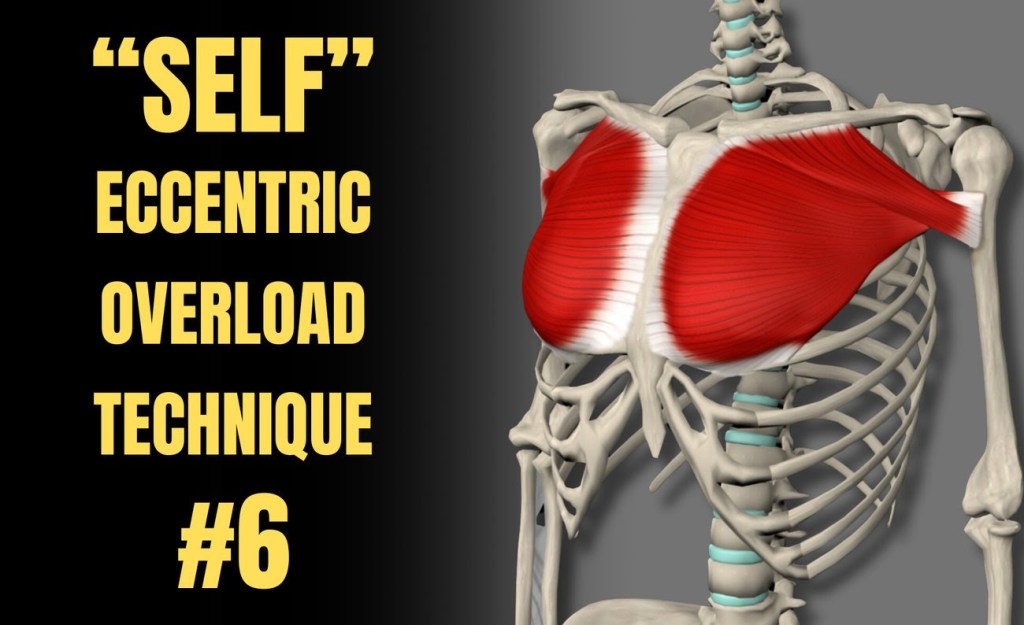
Today I’ll give you one for the chest!! It’s extremely effective, only requires a single dumbbell, and personally is one of my very favorite eccentric-overload to use
“Self-Spot” Eccentric-Overload Technique #6:
- Target Muscle: The Chest (Pectoralis Major)
- Exercise: Eccentric-Overload Single DB Press
(Note: The GIF below is sped up 3X due to email file size limits)

To perform it, you’ll grab a dumbbell that’s about 120% of your SINGLE-ARM 1 rep maximum, then use BOTH arms during the concentric phase (pressing out). At the top, remove one leg so that all the weight is being supported by the other, and use only that leg to resist the eccentric / negative phase (dropping the weight back down)!
Notice that during the concentric phase the dumbbell is centered on your chest. That will allow your “off” arm to truly take half or more of the weight, and will also help maintain balance. Then at the top you shift the dumbbell to the side, where it would be at the top of a normal DB press for that side. At that point, spreading your off arm out to the side will help counterbalance the weight on it’s way back down, which is particularly important if you’re doing these on a bench instead of the ground (which I frequently do).
In the demo I’m lying on the ground because it’s an extra safety measure if this is your first time overloading your chest. For one, it will prevent your elbow from dropping too far behind your back, which can be a risky position for shoulder injuries—particularly when using heavy weight. And second, you don’t have to worry about overbalancing and falling off the bench!
Once you’re comfortable with the movement you can move to the bench if you want to get some extra range of motion in the press, just make sure your feet are spread wide apart and are firmly on the ground.
As with all the other eccentric-overload techniques I’ve shown you, I recommend:
- Resisting hard enough that it takes a full 4 seconds to get from the top to the bottom of each eccentric rep
- Doing a full set overloading one side before switching to the other, rather than alternating back and forth with each rep.
- Since the “off” side will already be slightly fatigued from assisting during the concentric phases before being overloaded itself… take note of which side you started with, and the next time you use this technique start with the other side to ensure that you’re working both sides evenly! (Or, if you have a long rest period between sets, you can just switch which side gets overloaded first between each set.)
Application: Use this technique to eccentrically-overload your chest without a spotter OR any equipment!!
Regional Hypertrophy Side Note: In order to evenly work the upper, middle, and lower chest (aka clavicular, sternal, and costal heads), you’ll want to include incline and decline variations of this exercise! (You can find science-based regional hypertrophy techniques and tips for every major muscle in the body in the “Regional Hypertrophy Training” section of both All-Access Memberships!)
Relevant Previous FTF Tips (for All-Access Members):
1) Week 89 | “Self” Eccentric-Overload Technique #1: The Quads!
Relevant Research Article(s):
1) Eccentric Overload during Resistance Exercise: A Stimulus for Enhanced Satellite Cell Activation
Relevant Dr. Gains YouTube Video(s):
1) BEFORE YOU BENCH PRESS, Understand the Anatomy Behind it! (Incline, Decline, Close Grip, Wide, Form)
Relevant Dr. Gains Workout Program(s):
1) Hypertrophy Series Total Chest Programs (Full Gym & Free Weight Only Versions)
 Dr. Gains
Leave a comment