

With the New Year fast approaching, I thought I’d take the next 3 weeks to give you a few game-changing yet very little-known techniques and hacks that will allow you to tap into the neurobiology of your own brain, and leverage how it already works in order to smash your 2024 fitness goals!!
Like most people, I set goals for myself each year. Unlike most people, I almost always achieve them! No matter how long it takes. And the techniques I’ll share with you are to thank for it! I’ve always been fascinated by the brain (which is why I majored in Neuroscience), and one if the most important and useful things I’ve learned is how to set and achieve goals without relying on willpower.
The fact is that simple willpower isn’t enough. It dies off, and does so relatively quickly. Studies show that 23% of people quit their New Year’s resolutions within the first WEEK! And that rises to 43% before the end of January. The percent that actually ends up achieving their resolution is in the single-digits. And, importantly, studies have also shown that the level “tenacity”, or willpower at the time of setting the goal doesn’t correlate with eventual achievement at all!!
So simply telling yourself how badly you want it isn’t going to work! You need to understand how your brain actually functions, including the basic science behind long-term motivation and habit formation, and then set systems in place that are QUICK and EASY to implement, don’t just rely on willpower, and will virtually guarantee your success if you follow them!
The techniques I’m going to share will be pulled from my two YouTube videos on “13 Neuroscience-Based Brain Hacks for Setting & ACHIEVING Your Health & Fitness Goals!” Part 1 and Part 2, which are BY FAR my most underrated YouTube videos. Granted, they’re really old, and really long and dry. However, they’re absolute gold mines for anyone serious about habit change and goal achievement. (More concise breakdowns of all 13 hacks can be found in the Techniques, Principles & Theory section of the All-Access Basic Membership platform.)
So let’s get started!!!
For the sake of instruction, I’m going to refer to these hacks as applied to a single goal… but if you have multiple goals, you’ll just apply the techniques separately to each one (unless you’re using a specific hack called Simultaneous Goal Coactivation!)
HACK #1 – Subconscious Priming via Visual Fixation!
Part of the Brain Hacked:
-Visual Cortex and Amygdala
What To Do:
-WRITE your goal down on an actual, physical piece of paper (it needs to be specific, objective, and measurable), and then ATTACH A PHYSICAL PICTURE OR IMAGE (as vivid a one as possible) to that paper that represents your goal (in an achieved state if possible).
-Then simply LOOK at that image every morning when you wake up, or every night before you go to sleep, or both. Even a 1-second glance will suffice. You don’t even need to be conscious of having seen it… so if you tape of hang it up somewhere where your eyes will inevitably see it in the morning / night, that’ll work!
How It Works:
-The physical act of writing the goal and then attaching the image to it will link the image with your goal in your brain, due to several psychological and neurobiological factors that I won’t dive into, and more importantly it gives you something tangible to look at. From there, we’re hacking two different aspects of the brain simultaneously:
1) The more you look at something, the more your brain tells you it’s a part of yourself, and the more likely you are to choose whatever it is (or actions related to it), WITHOUT any conscious effort or decision to do so!
For example, in one study, scientists flashed a ton of random objects in front of people, and then later on told them to “randomly pick” from among them. The more times an object had been flashed in front of someone, the more likely they were to “randomly” (to their conscious mind) pick it!
Scientists call this phenomenon “Visual Fixations”, and it’s triggered by the primary visual cortex, which is located in the very back of the brain (see image below).
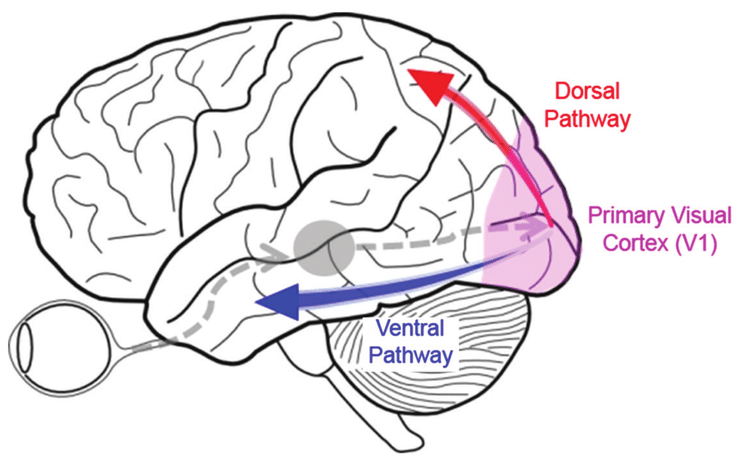
The more frequently the visual cortex sees something, the more importance it assigns to it – regardless of what your frontal cortex (your conscious mind) may think – and it will trigger other parts of your brain to act in accordance with that importance. This is why subliminal messaging can get you to buy a product without you even being consciously aware of having been visually influenced! (More on that next week).
Yes, subliminal messaging actually works, and it’s frighteningly powerful. But in this case, you can put it to work for yourself! Simply LOOKING at that image every day will subconsciously prime your brain to place more importance on it, making it easier for you to act in accordance with what that image represents – your goal!
2) The second reason this technique is so powerful has to do with the amygdala, and explains why you want as VIVID of an image as possible attached to your goal!
Motivation is mostly emotional. Think of it. The vast majority of the time, regardless of what “logic” may tell you… you do something because you feel like you want to do it. Or you avoid it because you don’t feel like doing it.
Emotions are generated and controlled within an area of the brain called the amygdala (see image below), which decides what emotion to feel and how to react to stimuli without any conscious procession or decision-making whatsoever (you can see below that the frontal lobe isn’t even involved in the pathway!), which is why emotions like fear can often be completely irrational.
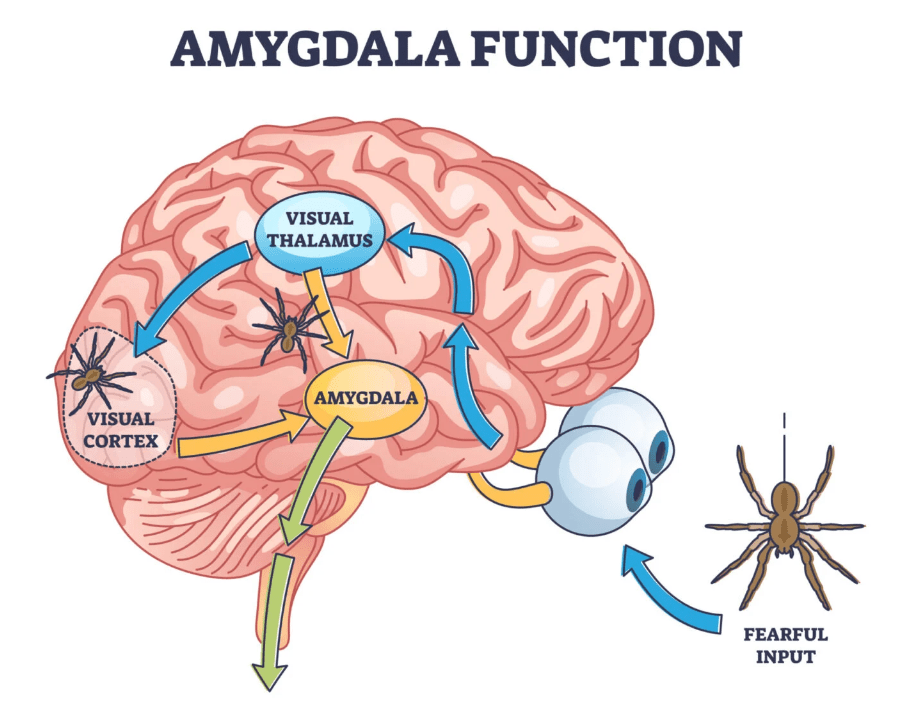
So, the more vivid your image is… the more positive emotion it will trigger. And the more positive emotion that’s triggered… the more the amygdala will tell the rest of your brain and body to act accordingly. Once again, WITHOUT any conscious will or effort on your part!!
Application: WRITE your goal down, ATTACH a VIVID IMAGE to it, and LOOK at it at least once a day! (Ideally first thing in the morning, or last thing at night)
Relevant Research Article(s):
1) Visual fixations and the computation and comparison of value in simple choice
2) Masked prime stimuli can bias “free” choices between response alternatives
Related Dr. Gains YouTube Video(s):
1) 13 Neuroscience-Based Brain Hacks for Setting & ACHIEVING Your Health & Fitness Goals! (Part 1)
2) 13 Neuroscience-Based Brain Hacks for Setting & ACHIEVING Your Health & Fitness Goals! (Part 2)
 Dr. Gains
Leave a comment