
I’m currently doing a Fitness-Tip Friday mini-series where I’m emphasizing a set of muscles that are significantly underrated as far as their overall importance – and therefore underworked by the vast majority of people! So far we’ve gone over the tibialis anterior, serratus anterior, flexor digitorum profundus, sartorius, erector spinae, soleus, gluteus medius, infraspinatus, and teres minor. (Note: if you just subscribed and want to view those, a catalogue of all previous FTF tips is included in the All-Access Basic Membership.) This week’s underrated & underworked muscle is the quadratus lumborum!! And it’s one you definitely do NOT want to overlook!
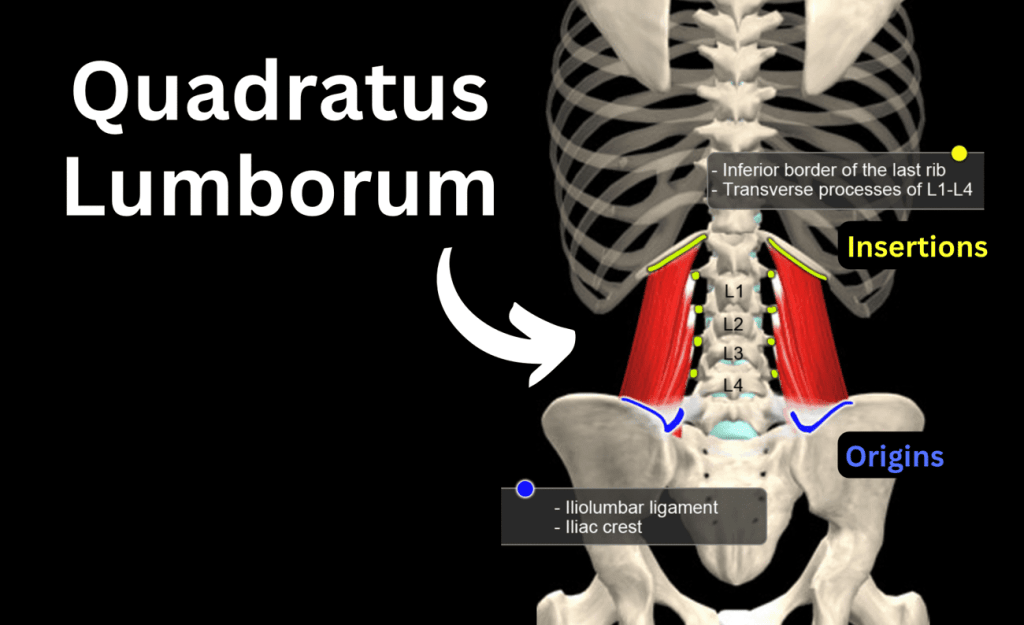
The quadratus lumborum, or “QL muscle” as it’s often called, is located deep in the lower back. It originates from along the top of the pelvis (specifically the iliac crest and iliolumbar ligament), and travels up to insert along the L4 – L1 lumbar vertebrae in the spine and the bottom of the last rib. (See graphic above)
Since the origins are below their insertions on the back, when the quadratus lumborum contracts it extends the lumbar spine, meaning it bends the lower back backwards (or, more often, prevents it from bending forwards):
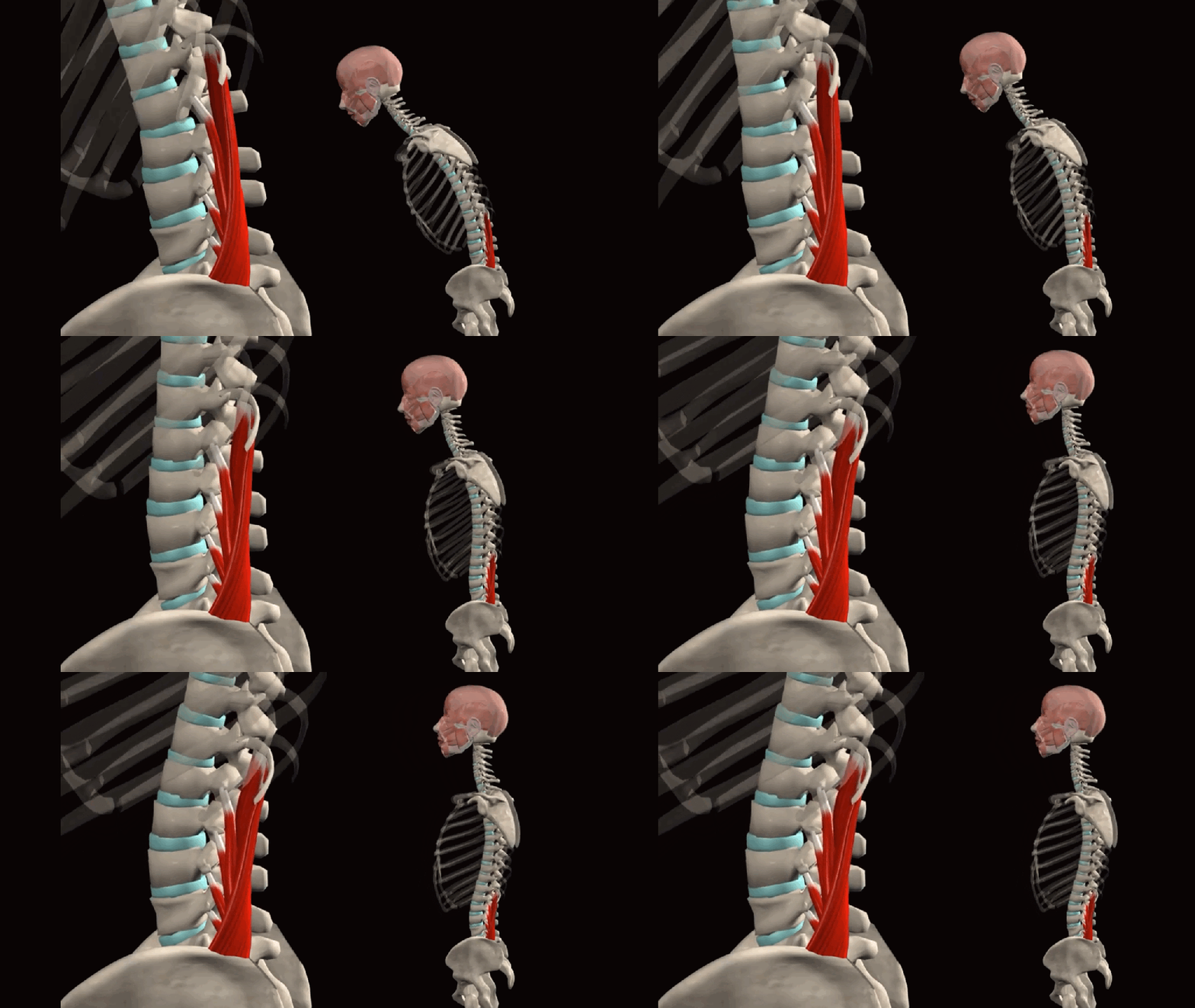
Also, since its origins are lateral or farther out to the side than its insertions, the quadratus lumborum also performs lateral flexion of the lumbar spine, meaning it bends the lower back to the side:

Overlooking the quadratus lumborum is one of the gravest mistakes you can make! Primarily because a weak QL is the most common mechanical cause of lower back pain! And not only that, but it also causes poor sitting posture, which creates a domino effect of many, many other musculoskeletal injuries and conditions. Finally, a weak QL drastically increases your risk of lumbar spine injury during exercises like the deadlift and squat!
Importantly, even those people who DO work their quadratus lumborum only work it along the sagittal plane – meaning straight forward and back, like this:
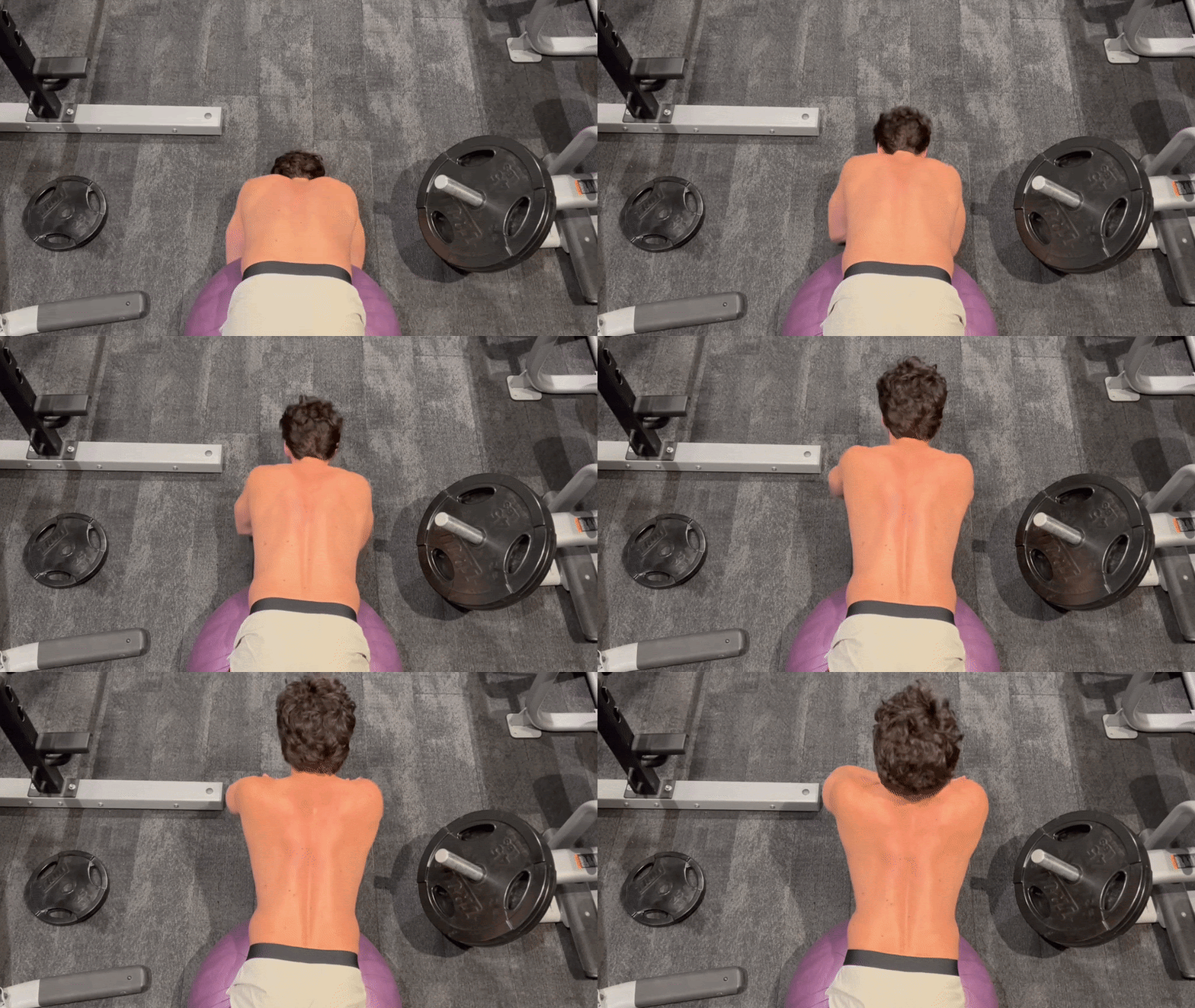
Which is definitely much better than nothing… however, you now know that the quadratus lumborum doesn’t just extend the spine straight back. It also pulls it to the side, i.e. the lateral plane! (Side note: working muscles along a single plane is one of the most common mistakes people make in general.) So, the BEST way to effectively and efficiently work the quadratus lumborum is to actually perform lower back extensions while simultaneously twisting your lower spine! Start with your upper body rotated to one side at the bottom, and then twist as you extend back until your upper body is rotated to the opposite side at the top! Then be sure to switch directions so that you’re working both sides equally.
Here’s what that looks like (featuring a photo-bomb from Koa boy 😆):

IMPORTANT: Make sure that whatever you’re using to support your lower body islow enough on your hips that it is your lumbar spine / lower back doing the movement, and not the thoracic spine / upper back – otherwise you’ll be working the erector spinae instead! Which is also important (hence it being featured earlier in this series), but not the purpose of this exercise. A stability ball works particularly well (if you have a workout partner or other method to secure your legs), and doesn’t dig into your legs or hips… but a Roman Chair or anything similar can also work as long as it’s not too high on your body.
Application: Stop ignoring your quadratus lumborum and start working it (with lateral twists)!! Your future back will thank you!
Relevant Research Article(s):
1) Back Pain: National Library of Medicine
2) Anatomy, Abdomen and Pelvis, Quadratus Lumborum
Related Dr. Gains YouTube Video(s):
1) Hit EVERY BACK MUSCLE in ONE COMBO EXERCISE!! (Plus “Fast-Twitch“ Finisher) – Using Any Free Weight!
 Dr. Gains
Leave a comment