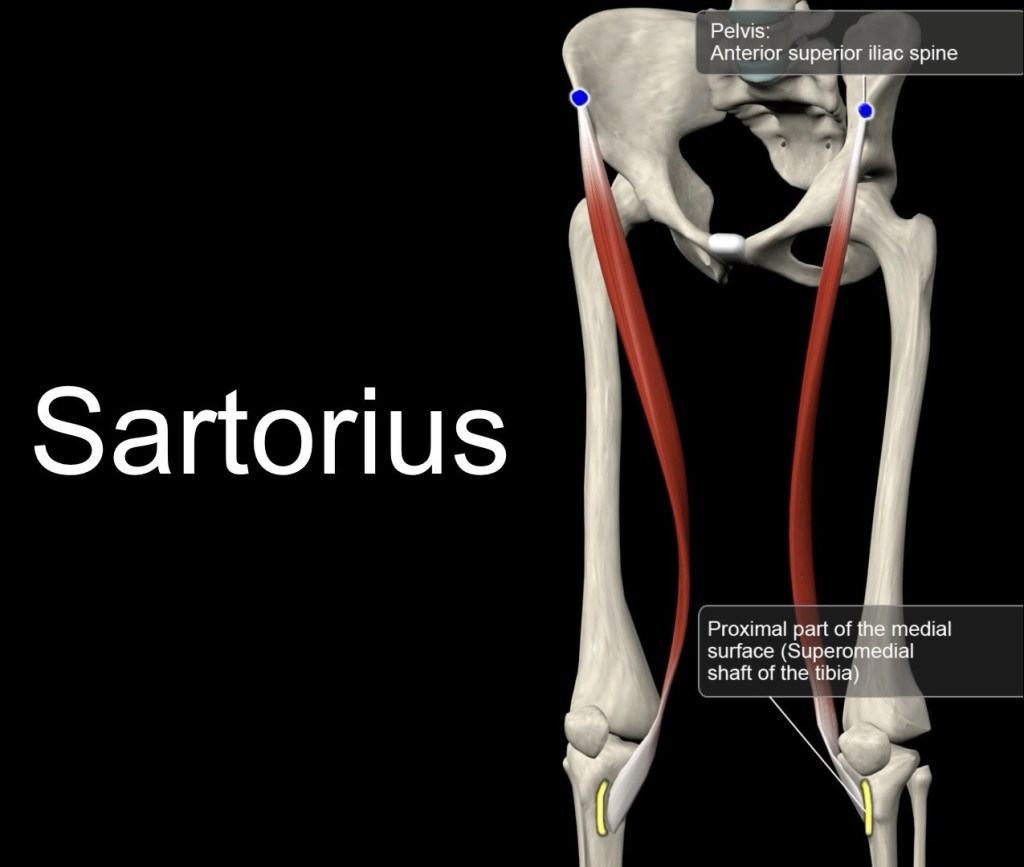
I’m currently doing a Fitness-Tip Friday series where I’m emphasizing a set of muscles that are significantly underrated as far as their overall importance – and therefore underworked by the vast majority of people! So far we’ve gone over the tibialis anterior, serratus anterior, and then last week the flexor digitorum profundus (note: if you just subscribed and want to view those, a catalogue of all previous FTF tips is included in the All-Access Basic Membership – see Deal of the Week below). And this week’s underrated & underworked muscle is the sartorius!!
The sartorius is the longest muscle in the entire body. It originates from the top front of the hip (anterior superior iliac spine), and then travels down (distally) and in (medially) while wrapping around the quads and inside of the knee to finally insert down on the shin bone (tibia). So it’s a biarticular muscle, meaning it crosses two joints – the hip and the knee – and that fact together with the unique path it takes across the body makes it responsible for an unusually wide variety of movements. It performs (click links to view anatomy GIF examples):
- Hip flexion
- Hip abduction AND adduction (complete opposites!)
- Hip external / lateral rotation
- Anterior pelvic tilt
- Knee flexion
- Knee internal rotation
That’s a whole lot of important movements!! So you can see how a weak sartorius could really mess things up… and on the flip side, the benefits that a strong sartorius can bring. For example, it’s a pivotal muscle for determining sprint speed and explosivity. The full list is too large to fully address here, so I want to focus on the primary issue at stake… which is the fact that the most important role of the sartorius is to provide hip / pelvic stability! For example studies have shown that a weak sartorius can be a primary cause of hip labrum impingements and tears! And while that’s true for men, it’s particularly prevalent among women – especially postpartum.
The sartorius also looks pretty darn cool when developed in someone with a low body fat percentage (although you usually only see it really high up on the thigh, and I don’t wear shorts that short, so no example pic from me 😆). And even in those without a really low body fat percentage, it helps to outline and define the “tear drop” area of the quads – the VMO – even if you can’t see the sartorius itself directly.
So how exactly do you work the sartorius??
Here’s the key. Some might think that because the sartorius performs so many movements, it’s sufficient to just have it be engaged during normal exercises targeting other synergistic muscles. However, the reason why that’s not an effective strategy is that, although it performs many movements… it’s NOT the primary agonist (muscle that takes on the most load) in ANY of them, or even the secondary agonist! So the larger, more powerful synergistic muscles take over during any one of those movements above.
The secret then is to use combo exercises that work more than one of the Sartorius’s movements simultaneously in a way that no other muscle does!
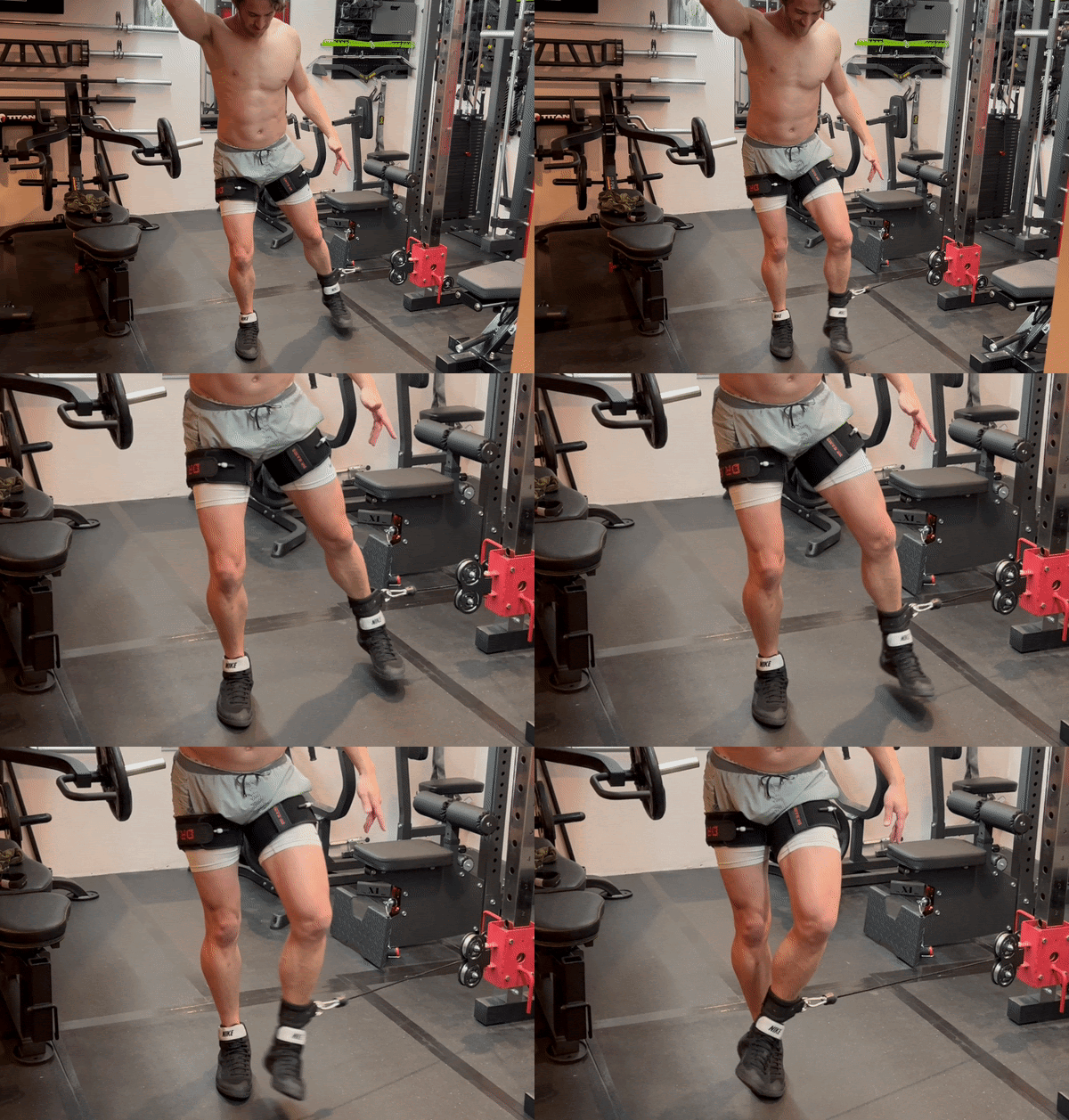
GIF #1 below demonstrates a technique I developed in order to do exactly that! (Although I haven’t given it a name yet… so let me know if you have any suggestions!) It combines no less than 4 sartorius movements into the same exercise (hip flexion + hip adduction + hip external rotation + knee flexion), ensuring that you work it far more than any other muscle!
INSTRUCTIONS:
Stand with a low-set cable off to one side and slightly behind you, and strapped to the ankle closest to the cable with your leg out to the side and slightly behind yourself, with your knee straight. Start by moving your leg at an angle forward (hip flexion) and in (hip adduction) until your leg is in front of your body, and then use a “hackey-sack” motion by externally rotating your hip, which will bring your ankle further in and up, while simultaneously bending (flexing) your knee.
There are many variations of this exercise you can and should perform. For example, in the GIF demo I’ve positioned myself and the cable to emphasize the hip adduction and external rotation aspects of the technique more than the others. But I’ll also use a variation where I’ll emphasize the hip flexion and knee flexion aspects more (to do that you need to be standing closer to the cable, be turned away from it a little more, and ideally either standing on a box or leaning forward so that the resistance pulls from a lower angle relative to the sartorius). As in all things with resistance training and fitness in general, variety is essential for success!!
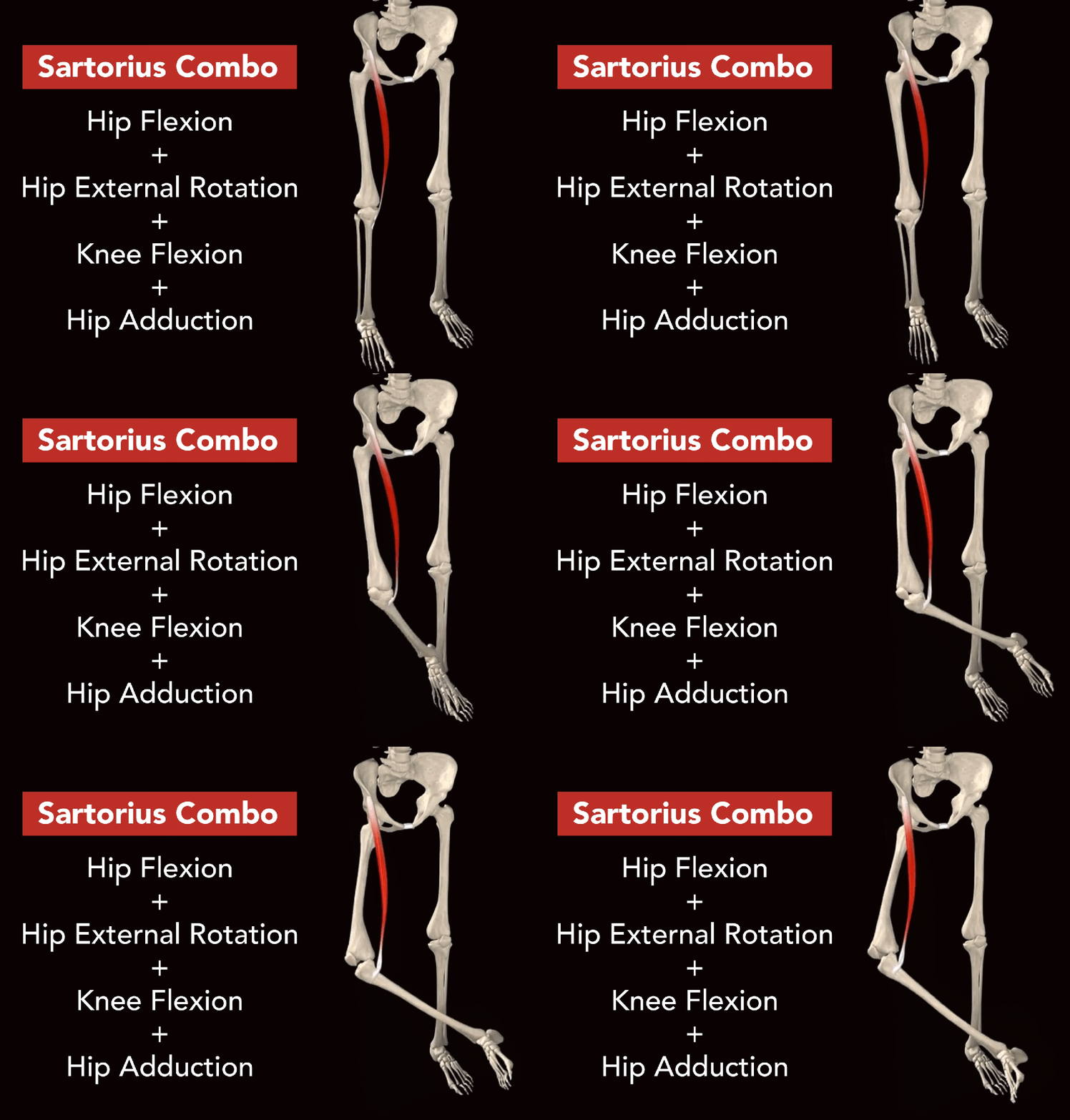
GIF #2 below does a decent job of showing you how the sartorius is engaged during a technique like this. If you don’t have access to a cable, it’s really hard to replicate the same effect using free weights… so the best alternative is to use a resistance band (this set is a little more on the expensive side, but is super high quality and includes ankle straps).
APPLICATION: Stop ignoring the sartorius and start reaping the benefits of training it directly!!!
Relevant Research Article(s):
1) Hip flexor muscle size, strength and recruitment pattern in patients with acetabular labral tears compared to healthy controls
2) Hip Muscle Activity During 3 Side-Lying Hip-Strengthening Exercises in Distance Runners
Related Dr. Gains YouTube Video(s):
1) WEIGHTED Lower Abs & Hip Flexor Workout Progression + Anatomy | V-CUT (Cables OR Resistance Bands)
GIF #1 – Sartorius Combo Technique
GIF #2 – Sartorius During a Combo Movement
 Dr. Gains
Leave a comment