

Two weeks ago for Fitness-Tip Friday I discussed the tibialis anterior, and how it is one of the most underrated muscles as far as its overall importance – and therefore underworked by the vast majority of people. You guys gave some great feedback on that, and this week I was thinking that there are several additional important muscles that fit into that category… so I decided to go ahead and make a mini FTF Series on it! And next up is another “anterior” – the serratus anterior!
The serratus anterior originates from the medial underside of the scapula (shoulder blade), and then fans out across the side of the chest with 8 or 9 finger-like sections that insert on the upper 8 or 9 ribs. And due to its location, it’s involved at least to some degree in virtually every single shoulder movement (there are 18 of them!! Click here to view all in-action), making it extremely influential in upper-body movement. However, it’s MOST directly responsible for 1) Scapular Protraction, 2) Scapular Upward Rotation aka Posterior Tilt, and 3) Scapular Abduction AKA Lateral Rotation.
Here are just a few of the reasons why it’s absolutely essential to train your serratus anterior!!
- A weak or tight serratus anterior is one of the most common causes of shoulder impingement injuries!! (including rotator cuff tears, labrum tears, bursitis, etc.), because it closes off the subacromial space (see Image #1 below)
- A weak serratus anterior is what causes winged scapula (although that can happen as a result of damage to the nerve that innervates the serratus anterior)
- A strong serratus anterior prevents neck and upper back pain by allowing your arms to move in a large range of motion without compressing the spine
- The serratus anterior is essential for all overhead movements and range of motion
- The serratus anterior protects your ribs, and prevents your shoulder blades from collapsing inwards when you push hard against something
- A developed serratus anterior opens up the chest and improves posture, while a weak serratus anterior leads to poor posture, which has a negative domino effect on many other parts of your body
- As with the tibialis anterior, it looks AWESOME when well developed with a relatively low body fat percentage!! (see Image #2 below)
So how do you work the serratus anterior?? By placing resistance against those very same movements that it performs as the primary agonist:
- Scapular protraction exercises (see GIF #1 below for an example)
- Scapular upward rotation exercises (see GIF #2 below)
- Scapular abduction exercises (see GIF #3 below)
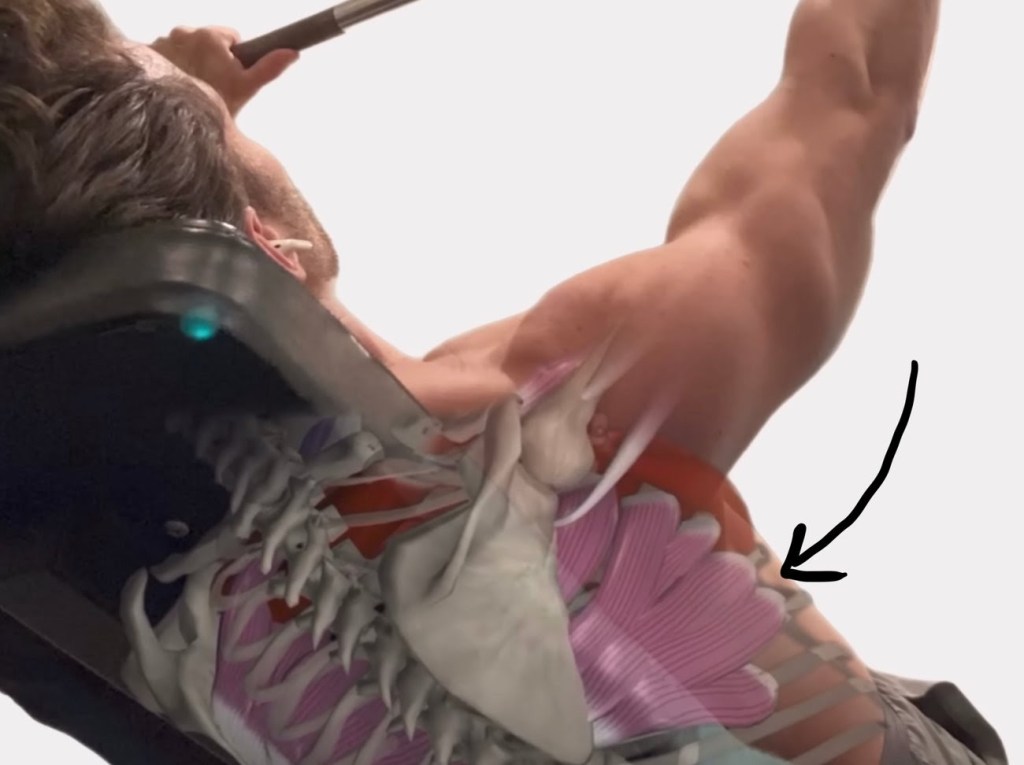
The serratus anterior also engaged in standard “push” type exercises, such as the bench press (see image #3 below).but only as a tertiary agonist at best. The pecs, anterior deltoids, and triceps take the vast majority of the load. So to really develop your serratus anterior, you need to target it directly via a wide variety of isolation exercises! You can check out more examples in this YouTube video I published a while ago on the serratus anterior.. and you’ll find even more techniques – along with how to properly integrate them into a comprehensive workout routine – in my Total Core Programs!
APPLICATION: Stop ignoring the serratus anterior and start reaping the incredible benefits of training it directly!!!
Relevant Research Article(s):
1) Anatomy, Thorax, Serratus Anterior Muscles
Related Dr. Gains YouTube Video(s):
1) The #1 Most Overlooked Muscle: Key to a Shredded Core, Back & Healthy Shoulders! (Serratus Anterior)
2) BEFORE YOU BENCH PRESS, Understand the Anatomy Behind it! (Incline, Decline, Close Grip, Wide, Form)
Image #1 – How the serratus anterior influences the subacromial space

Image #2 – Serratus anterior definition

Image #3 – Serratus anterior engaged during the bench press
GIF #1 – Scapular Protraction

GIF #2 – Scapular Upward Rotation (Plus Inclined Protraction)

GIF #3 – Scapular Abduction

 Dr. Gains
Leave a comment