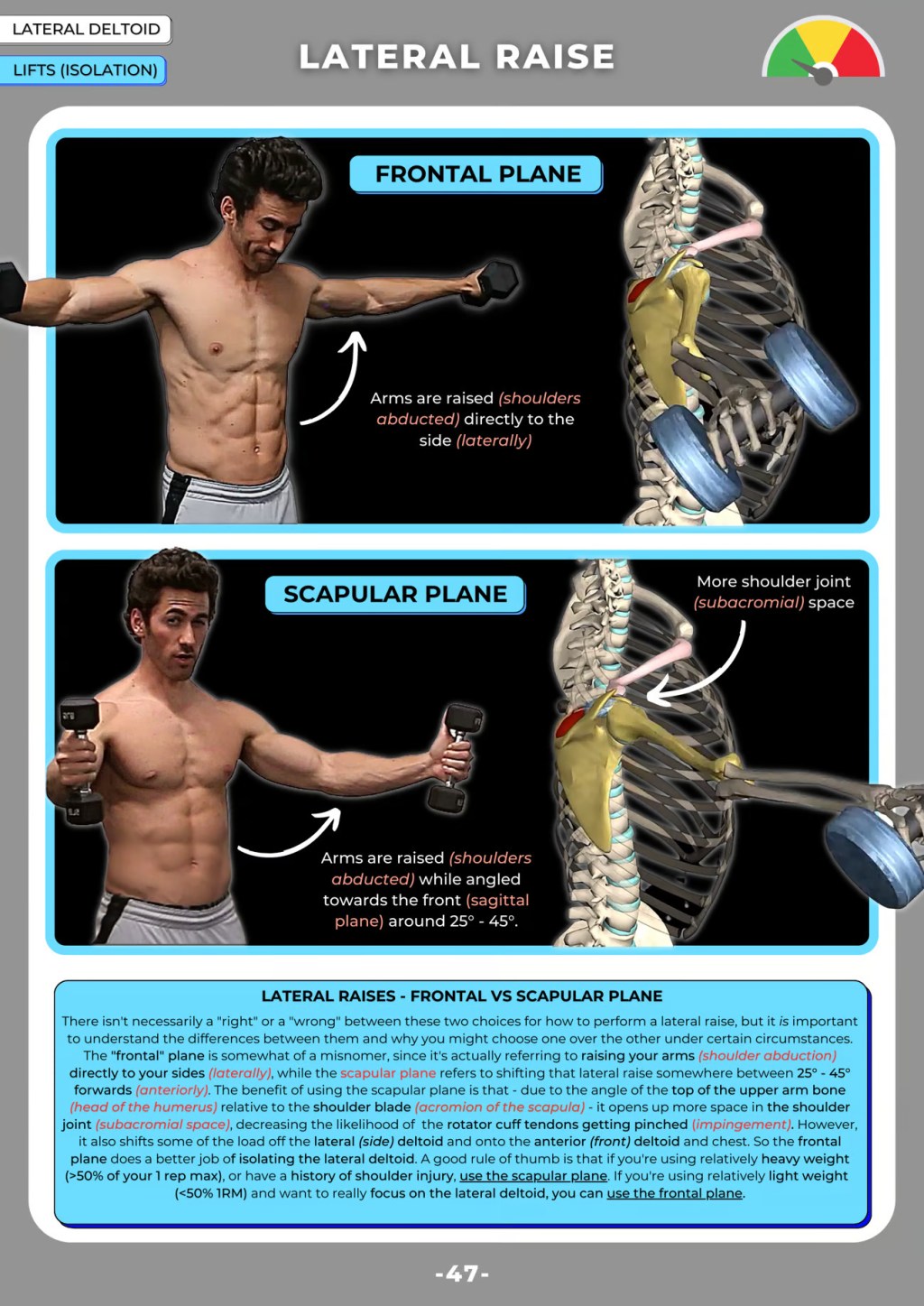
For this week’s tip I’m going to share an excerpt with you from my first, soon-to-be-finished e-book, which is dedicated to everything you need to know about working the shoulders!
I’ve inserted the actual e-book page for you below… but since I’m not sure how well you’ll be able to read the smaller text from inside an email (particularly if you’re using a phone), I’m also going to copy the text from the blue box titled “Lateral Raises – Frontal vs scapular Plane” at the bottom of the page.
Here it is! (Note that with all exercise-science terminology in my e-book I use the lay equivalents first in bold, and then I put the scientifically-accurate terminology next to it in red, italicized and in parenthesis.):
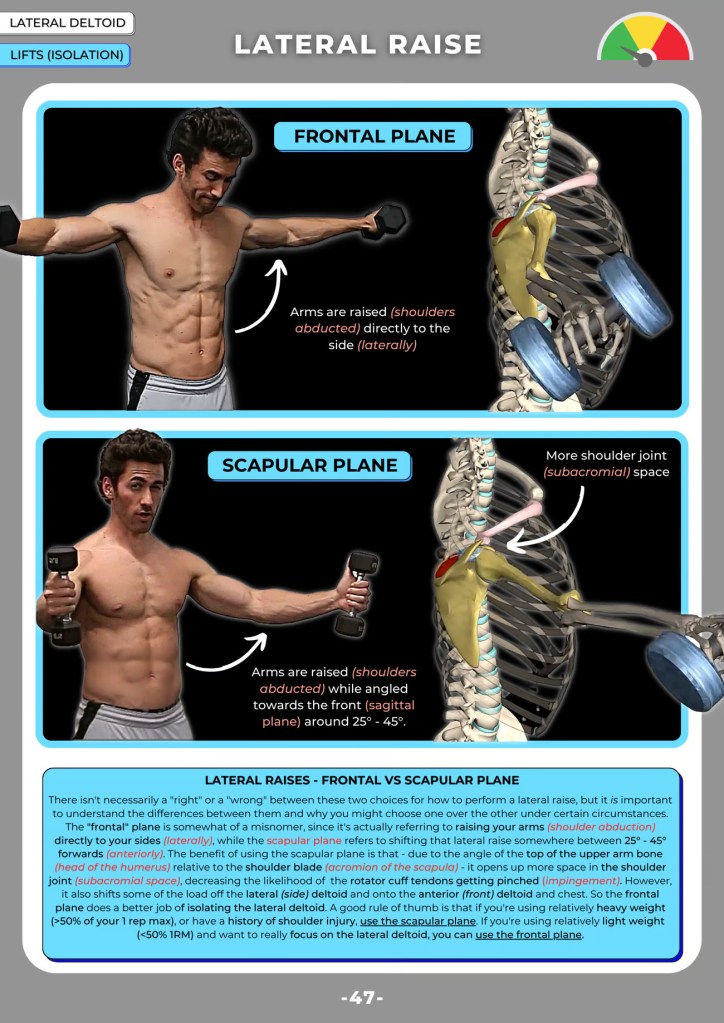
“There isn’t necessarily a “right” or a “wrong” between these two choices for how to perform a lateral raise, but it is important to understand the differences between them and why you might choose one over the other under certain circumstances. The “frontal” plane is somewhat of a misnomer, since it’s actually referring to raising your arms (shoulder abduction) directly to your sides (laterally), while the “scapular” plane refers to shifting that lateral raise somewhere between 25° – 45° forwards (anteriorly). The benefit of using the scapular plane is that – due to the angle of the top of the upper arm bone (head of the humerus) relative to the shoulder blade (acromion of the scapula) – it opens up more space in the shoulder joint (subacromial space), decreasing the likelihood of the rotator cuff tendons getting pinched (impingement). However, it also shifts some of the load off the lateral (side) deltoid and onto the anterior (front) deltoid and chest. So the frontal plane does a better job of isolating the lateral deltoid. A good rule of thumb is that if you’re using relatively heavy weight (>50% of your 1 rep max), or have a history of shoulder injury, use the scapular plane. If you’re using relatively light weight (<50% 1RM) and want to really focus on the lateral deltoid, you can use the frontal plane.
APPLICATION: Exactly what I say in that last sentence. If you’re using heavy weight or have a history of shoulder injury, use the scapular plane!! Otherwise it’s okay to use the frontal plane (i.e. directly to the side)
Note: If you’re wondering, the e-book should be finished within the next week, and I’ll be releasing it soon after! It’ll be available on Amazon, and perhaps a couple other platforms.
Relevant Research Article(s):
1) SCAPULAR MUSCLE ELECTROMYOGRAPHIC ACTIVITY DURING ABDUCTION EXERCISES IN THE SCAPULAR PLANE IN THREE POSITIONS
2)Deltoid muscle contribution to shoulder flexion and abduction strength: an experimental approach
Related Dr. Gains YouTube Video(s):
1) Deltoid vs Supraspinatus – the ANATOMICAL SECRET to EFFECTIVE LATERAL RAISES
2) Lifting With Shoulder Pain / Injury? This 10-Week Science-Based Program Will Change Your Life!
 Dr. Gains
Leave a comment