Table of Contents:
- Intro & Overview
- Disclaimers
- Reason 1) Basal Metabolic Rate
- Reason 2) Metabolic Adaptation
- Reason 3 – Excess Post-Exercise Oxygen Consumption (AKA The “Calorie Afterburn”)
- Reason 4) Only One Gets 2-for-1
- Reason 5) Time Efficiency
- Reason 6) Lifting Makes Dieting Easier (Counteracts Its Negative Effects); Cardio Makes Dieting Harder (Exacerbates Its Negative Effects)
- …Then Why Do So Many Sources Still Say Cardio Is Better For Fat Loss??
- Duke Research Faulty Design & Methods Case-Study
- 4 Key Supplements For Optimizing Post-Workout Burn & Recovery
Intro & Overview
Have you ever wondered why more than 90% of adults who lose weight will gain it all right back if not MORE within 3 years or less? Why it can be relatively easy to lose a significant amount of weight with diet and exercise in a short period of time.. But then incredibly difficult to KEEP it off long-term – even for the most disciplined of people?
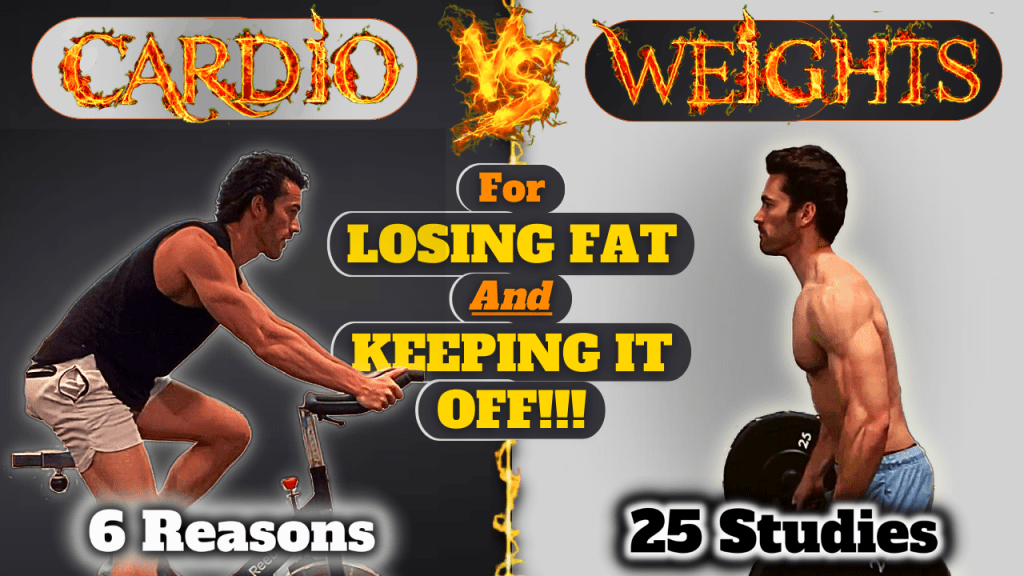
Well those are just a couple of the questions that’ll be answered in this video as I tackle one of the most-debated topics in the health & fitness industry, and an extremely important topic to understand for anyone looking to not only lose fat but actually keep it off long-term. For decades experts have gone back and forth arguing whether Cardio or Weight Training is better for fat loss. And while compelling evidence has been presented for both sides… the most common answer you’ll find by far will say that cardio is better, and that’s what most people assume. In fact if you just do a google search that’s what you’ll find as the top answer [insert Google screenshot]
However, in this video I’m going to give you 6 irrefutable science-based reasons pulling from more than 25 research studies to prove to you that Weightlifting, aka, Resistance Training is hands-down far more effective, and efficient, than Cardio for anyone looking both lose fat, and KEEP it off, and, much more importantly, for anyone looking to lower their body fat percentage which is a far better indicator of health and fitness.
Now first I’ll go over a couple disclaimers and lay down some ground rules to make sure we’re on the same page here, and that we’re comparing apples to apples moving forward.
Then we’ll dive right into those 6 evidence-based points that I’ll use to prove to you that weightlifting is more effective for long-term fat loss than cardio. And it’s important to understand up front that each one of these 6 points will build off of each other. Some you may have heard of, others probably not, but it’s extremely important that you get the full picture here of how all 6 reasons work together to answer this question – because while one or two of these reasons viewed by itself could be argued against, all 6 together are simply undeniable. And also, like I always say, it’s not enough just to know WHAT the answer is, you have to fully understand HOW and WHY , because that knowledge will empower you to really apply these principles to your own unique situation, so that you can achieve success in your own fitness journey. So even if it means you have to stop the video and come back to it later, make sure you watch and understand all 6 points.
And finally I’ll finish by explaining why, if all of this is true, you’ll see so many experts and research articles claiming the exact opposite – including the top answer on a google search. And that part you don’t want to miss either, because you want to know how to respond to all the people and sources you’ll hear giving you “proof” that cardio is more effective weight training.
And guys if you find any of the content in this video valuable, I’d truly appreciate you hitting that like button and leaving me a comment below, I love the feedback and it’ll help others to find my channel, and make sure to subscribe and turn on those post notifications so that you don’t miss any of my future content.
Disclaimers
First disclaimer:
- Just so that you don’t get confused, in this video the words Weightlifting / Resistance Training / Anaerobic Exercise are used interchangeably. Just three ways of saying the same thing, and similarly Cardio / Endurance Training / Aerobic Exercise are all used interchangeably for the same thing.
- Second – There are many different types of cardio and each will have a slightly different effect on the body. But in this video, when I refer to “Cardio”, I’m talking about “Steady-State Long-Duration Cardio”, which is where you’re performing the same action for an extended period of time, such as running, biking, swimming, etc, and that is what almost all experts and research studies are referring to in this cardio vs weightlifting debate.
- Obviously, your diet and nutrition are an enormous factor in fat loss, and if you’re not doing that right, it’s not really going to matter whether you’re doing cardio or weight training. But that’s a separate topic and is not what we’re addressing here. So just keep in mind that our discussion on cardio vs weight training assumes that you’re eating well, and there’s no difference in diet between the two regimens. So, given the same diet and nutritional intake, which is better.
- And final disclaimer – if you watch this video all the way through you will come away from this video completely convinced that resistance training is better than cardio for long-term fat loss. HOWEVER, I want to be clear, I am NOT telling you that cardio is bad, or that you should stop doing cardio, or even that it’s not effective for fat loss! In fact the MOST effective fat-loss regimen actually combines cardio and weightlifting, as long as it’s done correctly, in the right amounts, right order, etc. There are many benefits to cardio and I include aerobic exercise in all of my private clients’ workout regimens. However, that’s how a lot of experts will answer this question of which is better for fat loss, they’ll just say do both, but that’s really just a cop out because it doesn’t answer the question. You already know that. So the purpose of THIS video is to answer the hypothetical question of “if you HAD to pick between only doing cardio or weightlifting, to achieve the specific goal of long-term fat loss, which would be the better choice!”
Reason 1) Basal Metabolic Rate
Now that we have that clear, let’s jump into Reason Number 1, which has to do with something extremely powerful and important called your Basal Metabolic Rate – also called your Resting Metabolic Rate – which, to put it very simply, is the rate that your body burns calories just from being alive. Basically the BMR tell us how many calories you’d burn in 24 hours if you stayed in bed all day, without moving, binging Netflix – which, or course, you would never do… right??
So – just how important is your Basal Metabolic Rate? How big of a difference does it actually make?
In a well-known study published by the International Society of Sports Nutrition in 2014 (https://pubmed.ncbi.nlm.nih.gov/24571926/), researchers tracked all the calories that human beings burn in a day – called the “Total Daily Energy Expenditure”, and broke them down into four different categories to find out how much of our total daily burn came from each category. They found that only about 5% of calories were burned as a result of exercise, 10% from the thermic effect of food, which are the calories we burn from digesting the food we eat during the day. 15% come from Non-Exercise Activity, such as getting out of bed, walking up the stairs to work, etc. And a whopping 70% of our total calorie burn is from our Basal Metabolic Rate – which is the rate we burn calories at rest. Watching TV on the couch or sleeping in your bed.
Now this isn’t exact, and someone who exercises for 8 hours a day is going to have a higher percentage of their total burn come from exercise… but for one – this study analyzed athletes, so they’re already exercising more than the average individual. And second, any variation or increase there may be is going to be inconsequential. “If you want to experience how inconsequential the during-exercise calorie burn is, jump on a treadmill or bike that measures the approximate amount of calories you’re burning.. And stay on it for an hour. Then take the total amount of calories you burned during that hour (which, by the way will be an average of around 300 calories), and calculate how long you’d have to continue exercising in order to match the total amount of calories you eat in a day, and if you haven’t done this before… you’ll be shocked. For example, my personal burger of choice is the Baconator from Wendy’s. It’s amazing. It also contains 950 calories. So I’d have to bike for 3 hours, just to burn off that Baconator!
Now, I’m not trying to convey here that exercise is pointless and hopeless, cause it’s not. What I am trying to convey is that really no matter what you do, any change in the amount of time you spend actually exercising will be completely inconsequential for your total daily burn, compared to the effects that changes to your Basal Metabolic Rate will have.
It DWARFS everything else as far as its importance in determining how many calories your body is going to burn in a day. So anything we do that affects the BMR is going to make by far the largest difference in losing weight.
And what is the number 1 factor that determines how efficient our Basal Metabolic Rate is? Countless studies have confirmed that much skeletal muscle you have (https://www.ncbi.nlm.nih.gov/pmc/articles/PMC296885/). A pound of muscle will burn more than 4 times as many calories at rest as a pound of fat – and that doesn’t include all the extra calories burned when the muscles are actually being used, for walking, eating, or anything. In fact, skeletal muscle in the average adult is responsible for 20-30% of entire TDEE (https://academic.oup.com/ajcn/article/92/6/1369/4597507?ijkey=b8423541a0948efb0d06bcc05795404aa8996e3a&keytype2=tf_ipsecsha).
So the more muscle you have, the higher your BMR, and the more calories your body will burn without you doing a single thing.
And how do you build more muscle? By lifting weights. Resistance training is essential for muscular hypertrophy or muscle growth – it literally can’t happen without it. All the steady-state, long-duration cardio in the world will not increase your muscle mass (https://pubmed.ncbi.nlm.nih.gov/20386333/ “it cannot increase protein synthesis”.
In fact, studies have shown that it actually inhibits the muscular hypertrophy pathway (https://journals.lww.com/nsca-jscr/Fulltext/2012/08000/Concurrent_Training__A_Meta_Analysis_Examining.35.aspx “significant negative relationships between frequency (−0.26 to −0.35) and duration (−0.29 to −0.75) of endurance training for hypertrophy, strength, and power.”
So, for example, if you do a bunch of cardio right before you lift weights, you won’t be able to lift as much and what you do lift won’t induce the same amount of muscle growth that it otherwise would (https://journals.lww.com/nsca-jscr/Fulltext/2016/03000/Performance_and_Endocrine_Responses_to_Differing.12.aspx) “When implemented as part of a concurrent training regimen, higher volumes of endurance training result in the inhibition of lower-body strength, whereas low volumes do not.”
I’ll do a deeper dive into that inhibitory effect in a future video, but that leads us to the flip side of Reason 1, which is that not only does cardio not increase your BMR like weight training does… but by itself it actually decreases it.
A study published just last year in Medicine & Science in Sports & Exercise (https://journals.lww.com/acsm-msse/Citation/2021/10000/Effect_of_Aerobic_Exercise_induced_Weight_Loss_on.15.aspx ) took overweight, sedentary participants and had them engage in a rigorous, measured aerobic exercise regimen while carefully controlling and measuring their diet. After 24 weeks of this regimen, the weight loss that occurred was less than half of what it should have been, given their energy intake and output. And they found that it was because the participants RMR had dropped by an average of 4%! More on that here shortly
For now, to summarize Reason 1, resistance training builds muscle, which significantly increases your RMR, which makes your body burn significantly more calories long-term. While cardio decreases your RMR, which makes your body burn fewer calories long-term.
But, as significant as that is, it’s only a small piece of the pie. In fact different effects these exercises have on our BMR is only part of a larger phenomenon, which is my Reason 2 – Metabolic Adaptation!
Reason 2) Metabolic Adaptation
To explain this phenomenon, let’s take Bob here, who’s very overweight and hasn’t exercised in years. If he were to start jogging for 20-30 minutes every day, he’d soon start to see some significant fat loss. However, after a few weeks and then a few months of doing that, he’ll start to see that just running 30 minutes doesn’t achieve the same effect. He’ll have to run for 40, then 60, then 90 and on to achieve the same fat loss results that he initially achieved with just 30!
What’s happening is that his body is undergoing several different changes (show https://pubmed.ncbi.nlm.nih.gov/24571926/ “Energy restriction is accompanied by changes in circulating hormones, mitochondrial efficiency, and energy expenditure that serve to minimize the energy deficit, attenuate weight loss, and promote weight regain.”
that together we call metabolic adaptation. Our bodies create fat in order to store energy for future use. Well when your body starts to see that it’s losing those stores of energy to this activity you’re doing, it starts to make adjustments in order to try and conserve them.
The first one we’ve already discussed – it will lower your BMR to burn fewer calories at rest.
Second, it’ll overcompensate by modifying your hormone release (https://pubmed.ncbi.nlm.nih.gov/28481261/ “energy gap in which more energy is desired than is required. The increased hunger is associated with elevation of the orexigenic hormone ghrelin and decrements in anorexigenic hormones. The lower total daily energy expenditure with diet-induced weight loss results from (1) a disproportionately greater decrease in circulating leptin and resting metabolic rate (RMR) than would be predicted based on the decline in body mass, (2) decreased thermic effect of food (TEF), and (3) increased energy efficiency at work intensities characteristic of activities of daily living. These metabolic adaptations can readily promote weight regain.”
drastically increasing how much ghrelin your gut releases – which is the hormone that tells you you’re hungry – and drastically decreasing how much leptin it releases, which is the hormone that tells you you’re full, so that your body thinks it needs more energy than it really does.
Third, it will decrease the thermic effect of food, (https://pubmed.ncbi.nlm.nih.gov/28481261/ “(2) decreased thermic effect of food (TEF)” which if you remember from the energy chart is how many calories your body burns from digesting what you eat.
Fourth, it will change how your neurons respond to seeing and eating food (https://pubmed.ncbi.nlm.nih.gov/21496461/ ”These changes in appetite may be mediated by alterations of peripheral appetite-related signals, such as leptin and meal-related gut peptides, promoting energy intake. Furthermore, significant changes in the neuronal response to food-related cues in the weight-reduced state have also been shown, stressing the importance of the interactions between homeostatic and non-homeostatic regulation of energy intake”
And finally, it will change the brain itself, (https://pubmed.ncbi.nlm.nih.gov/21496461/ “The difference in neuronal response with overfeeding as compared to eucaloric feeding in reduced-obese as compared to thin individuals in response to foods of high hedonic value is shown [28]. A. Greater deactivation of the insula, hypothalamus and visual cortex is noted in thin as compared to reduced-obese individuals (p < 0.01)” De-activating areas of the brain that tell you you’re eating too much!
All in an effort to minimize weight loss, and promote weight gain (https://pubmed.ncbi.nlm.nih.gov/24571926/ “Energy restriction is accompanied by changes in circulating hormones, mitochondrial efficiency, and energy expenditure that serve to minimize the energy deficit, attenuate weight loss, and promote weight regain.”
And all of it triggered by long-duration cardio, making it harder and harder for you to use cardio to lose weight over the long term.. With the result being that the vast majority of people who use dieting and cardio to lose weight, will have great short-term results… but then just gain it all right back!
Weightlifting, on the other hand, not only doesn’t trigger these same metabolic adaptations, but it can actually COUNTERACT them. Which I’ll go over in more detail in Reason 6.
However, the fat loss advantages of resistance training over cardio isn’t only in the long-term – it has multiple short-term advantages as well.
Reason 3 – Excess Post-Exercise Oxygen Consumption (AKA The “Calorie Afterburn”)
What it boils down to is that there is a short-term increase in metabolism after a workout session. But how significant that increase is and how long it lasts depends on the type of exercise performed.
A study published in the European Journal of Applied Physiology (https://link.springer.com/article/10.1007/s00421-001-0568-y?LI=true) found that after just a 30-minute weightlifting session, metabolism was boosted via the afterburn effect for over 38 hours. So, for example, for almost two full days after lifting weights, you’re burning 100 calories per hour instead of 80 while you watch Netflix. Now, 20 in an hour may not sound like much, but multiply that by 38, and you’ll see it makes a huge difference!
And another study (https://pubmed.ncbi.nlm.nih.gov/8973975/) proved that the more intense the weightlifting session is, the larger and longer the effect will be, while increasing duration had no significant effect. Which tells us that it’s not any aerobic effect of weightlifting that’s boosting the afterburn – it’s the actual lifting of weights itself!
On the flip side, cardio – regardless of how long or intense the session is, has been shown to have minimal effect on Post-Exercise Oxygen Consumption. A study published in the Journal of Sports Science found that after participants performed aerobic exercise for 80 minutes at 80% of their maximum heart rate (so at a very high intensity), only had elevated metabolism for 7 hours (https://bodyrecomposition.com/research/epoc-after-exercise ), despite the fact that the 80 minute aerobic session was almost 3 times as long as the weightlifting session was!
Finally, a recent meta-analysis (https://pubmed.ncbi.nlm.nih.gov/28513103/ ) looking at dozens of similar studies concluded that cardio is unlikely to stimulate any significant post-exercise fat loss.
More info on how to make sure your post-exercise burn and recovery is as effective as possible at the end of the video!
Reason 4) Only One Gets 2-for-1
You can get all the primary benefits of cardio from resistance training.. But you can’t get all the primary benefits of resistance training from cardio.
And this is probably the biggest reason why I say that if you have to pick one, pick resistance training! Of course, there are many proven mental and emotional benefits of exercise… but you can get those from either type of exercise, so what differs between them are the physical benefits. If you look at the physiological benefits of cardio, there are two that stand out – there’s the fat loss that comes from aerobic metabolism, then there are the cardiovascular benefits of cardio – which are the primary reason why almost every healthcare practitioner in the world will recommend it,. Regular cardio can and will improve your blood pressure, decrease your risk of a heart attack, and dozens of other cardiovascular conditions.
How does it do that? By forcing your heart to work harder, the heart is a muscle, so to put it simply the more you work it the stronger it gets. The American Heart Association defines aerobic exercise or cardio as “activity [that] gets your heart rate up” thereby improving your heart health,
(https://www.heart.org/en/healthy-living/fitness/fitness-basics/aha-recs-for-physical-activity-in-adults) and they recommend that adults get either at least 150 minutes a week of moderate aerobic exercise (defined as elevating your heart rate to between 50% – 70% of your maximum heart rate) or 75 minutes a week of intense aerobic exercise (defined as any activity that elevates your heart rate to between 70 – 85% of your maximum heart rate).
I promise you, if you go through any of my Hypertrophy Series Weightlifting Programs, and you complete the workout with the specified timeframe, intensity, rest times, etc… your heart rate will be well above 50% of its max for at least that amount of time, giving you, by definition, all the cardiovascular benefits of a “moderate-intensity aerobic activity”. And if you go through one of my Shred Series programs, your heart rate will be well above 70% of its max for much more than 75 minutes a week, giving you, by definition, all the cardiovascular benefits of a high-intensity aerobic activity.
There’s a special term for this and it’s called Metabolic Resistance Training (https://www.precisionnutrition.com/rr-cardio-vs-weights?utm_medium=social&utm_source=youtube&utm_campaign=youtube-description-20211015-pncoaching-weightvscardio), but whatever you call it, you can design your weightlifting sessions in such a way that you get all the cardiovascular benefits of a “cardio” session, while simultaneously getting all the benefits of resistance training.
In fact, research has shown that there are some aspects of cardiovascular health that resistance training does an even better job of improving than cardio does! A study published in the Journal of Human Hypertension
(https://pubmed.ncbi.nlm.nih.gov/9004105/) had one group do only weight training, and another do only aerobic exercise. And after just 6 weeks, they found that the weightlifting group had a greater increase of blood flow and venous capacitance, less increase in systolic BP (SBP) and a greater fall of forearm vascular resistance (in response to stress) – all of which are strong indicators of cardiovascular health – even though the weightlifting group only exercised 3 days a week while the aerobic group exercised 4.
And as for the fat loss benefits of aerobic metabolism, there are other techniques you can use other than just adjusting the intensity and rest times in order to boost the metabolic and aerobic demand of your weightlifting session.
One of those techniques is called Peripheral Heart Action Training, where you superset or pair two exercises together that work opposite ends of the body, forcing your heart to work harder. For example, if you did a set of leg extensions, your heart would pump a ton of blood into your legs. Then, if you superset that with an incline press, your heart would have to then pull all that blood from your legs and pump it up into your upper chest and arms. The result is a significantly greater increase in heart rate than if you were to superset two exercises targeting the same general region – without requiring any increase in the intensity of the lifts. A study in 2015 even showed that Peripheral Heart Action Training resulted in even greater cardiovascular health improvements than HIIT – a popular form of High-Intensity Aerobic Exercise – over a span of 3 months.
So, the important point here is that there are multiple ways to make your weightlifting sessions as aerobically demanding as cardio – and thus giving you the fat burning benefits of cardio – while simultaneously giving you the benefits of resistance training.
But the reverse is not possible.
As we already went over, cardio cannot give you the same increase in muscle mass and strength or boost that resistance training can, or increase your BMR, or give you the same post-exercise calorie afterburn, but there are also many other benefits unique to resistance training, such as increasing bone density which counteracts osteoporosis, injury prevention, joint rehabilitation, improving posture, all of which have been proven time and time again as benefits of weight training.
https://pubmed.ncbi.nlm.nih.gov/22777332/
https://pubmed.ncbi.nlm.nih.gov/12831709/
https://pubmed.ncbi.nlm.nih.gov/11676593/
https://www.ncbi.nlm.nih.gov/pmc/articles/PMC6377696/
So, to summarize Reason 4, resistance training provides unique fat loss effects and other benefits that you can’t get by doing cardio.. while you can get the fat loss AND cardiovascular benefits of cardio by doing resistance training. Which brings us to Number 5…
Reason 5) Time Efficiency
which is that not only can you get cardio and resistance training benefits from weightlifting… but you can get those benefits while requiring much less time spent actually exercising! Or in other words, Resistance Training is a much more time-efficient method of fat loss, making it the better choice for anyone who has an extremely busy schedule.
And you can see that in several of the studies and scientific principles that we’ve already discussed:
–In one study the resistance training group achieved greater cardiovascular benefits despite only working out 3 days a week to the aerobic group’s 4
–Resistance training resulted in a drastically higher boost in post-exercise metabolism while requiring just a fraction of the time as cardio
–The boost that RT gives to your BMR is a huge time-saver since you won’t have to be actually exercising for as long in order to hit your daily calorie burn goals (while cardio actually drops your BMR, meaning you’ll have to spend more and more time exercising to make up for that)
–For a new example, a study published in the Journal of Hepatology in 2017 (https://pubmed.ncbi.nlm.nih.gov/27639843/) showed that weight training achieved the same improvements in lipid metabolism that cardio did, while requiring much less time and energy. Meaning weight training is much more time-efficient in helping your liver to break down fats.
-Finally this is what I think sums it up best. Research (https://pubmed.ncbi.nlm.nih.gov/11676593/) has shown that virtually all the benefits of resistance training can be obtained in just two 15-20 minute sessions per week (https://pubmed.ncbi.nlm.nih.gov/12629559/). For a total of 30-40 minutes. While cardio requires 75-150 minutes. And even then, can’t provide the same benefits that resistance training can.
So to summarize my Reason Number 5, Resistance Training is a much more time-efficient method of fat loss than cardio, making it the better choice for anyone who has a busy schedule. Or who simply values their time!
Reason 6) Lifting Makes Dieting Easier (Counteracts Its Negative Effects); Cardio Makes Dieting Harder (Exacerbates Its Negative Effects)
Finally, my Reason number 6 that weight training is better for long-term fat loss than cardio, is that weight training can counteract or negate the two largest pitfalls of dieting, while cardio cannot.
Most people who want to lose fat will go on some type of calorie-restricted diet. And for good reason – no matter what exercise you do, you’ll have a really hard time burning fat if you don’t consume fewer calories than you burn. However, there are two main downfalls or challenges that it presents.
- Is that, similar to cardio, a restricted diet will lower your RMR. When your body sees that energy input has decreased, it will try to compensate for it, conserving what it can by decreasing the number of calories it burns throughout the day and night. And remember your RMR accounts for most of the calories you burn every day, so dropping it makes a huge difference in how much fat you’re going to actually be able to burn each day.
- Is that a restricted diet won’t just result in losing fat, it’ll also result in losing lean body mass – losing muscle. And since how much muscle you have is the primary factor in your RMR, it will combine with your body’s metabolic adaptation to further decrease the number of calories you burn each day while you’re not exercising.
A study published in the Journal of the American College of Nutrition (https://www.tandfonline.com/doi/abs/10.1080/07315724.1999.10718838) had subjects go on a restricted diet of 800 calories per day for 12 weeks, and then during that time had one group do only aerobic exercise and the other only resistance training.
They found that the cardio + diet group lost about 8% of their lean body mass, while the weightlifting + diet group lost NONE. And the cardio + diet group’s RMR dropped significantly, while the weightlifting + diet group’s RMR actually increased significantly, despite the extreme calorie deficit and despite the fact that the cardio group exercised 4 days a week while the weightlifting group only exercised 3.
So the moral of the story. If you truly want to lose fat, you’ll want to go on some form diet where you’re consuming fewer calories than you burn. But that will get harder and harder to do and less and less effective as your body starts to adapt and compensate for it. Weightlifting by itself while you diet will completely counteract that adaptation, enabling you to efficiently burn calories throughout the day, while cardio by itself while you diet will be unable to counteract those negative effects, and will actually further decrease your body’s ability to burn calories throughout the day.
(Now there is one other strategy you can use to prevent these negative effects of dieting, in the form of a supplement you can take, and I’ll go over that at the end of this video.)
…Then Why Do So Many Sources Still Say Cardio Is Better For Fat Loss??
But with all this evidence, WHY do so many experts and researchers still say that Cardio is better than Resistance Training for fat loss???
There’s several reasons for that, and I’ll give you the top 3. The first and perhaps the biggest is this: THEY DON’T DIFFERENTIATE BETWEEN FAT LOSS AND WEIGHT LOSS!!! As if losing a pound of fat, and a pound of muscle, were equally beneficial!
If weight loss was the goal, regardless of how or where that weight comes from, there’s much faster ways to achieve that. You could just amputate an arm or a leg and lose a few dozen pounds instantly. You could get the flu and puke pounds out, or go into a coma and atrophy pounds off. Obviously these are extreme examples, but you get the point that weight loss is not the goal.
Now, some studies are a little better and measure FAT loss… yet that’s still not a good indicator of success or even health improvement. For example, if I were to run a study that had two people – Bill and Bob – do two different exercise regimens, and Bill lost 5 pounds of fat, while Bob lost 10 over the same amount of time. I could publish that study saying that exercise regimen A was twice as effective for losing fat.
But what you don’t know is that Bill with a total of just 20 pounds of visceral fat on their body, while Bob started with 100. And Bill put on a bunch of muscle during that month, increasing their lean body mass from 100 to 110 pounds, while Bob actually lost lean body mass, dropping from 100 to 90 lbs.
If you do the math, you’ll find that Bill actually cut their body fat percentage by a third – a 33% improvement in body composition, while Bob’s body fat percentage did not change at all. So despite the fact that he lost twice as much fat as Bill did, and lost a FOUR TIMES more weight than Bill, there was no improvement whatsoever in his body composition. So even though I could publish that study saying that exercise regimen A was twice as effective at losing fat as regimen B, and I’d be correct… it would be incredibly misleading because regimen A was actually many times more effective at dropping body fat percentage and improving body composition than regimen B.
Bill Started 100 lean + 20 fat, ended 110 lean + 15 fat
(20 / 120 = 17% bfp) (15 / .12 = 12% bfp)
Bob Started 100 lean + 100 fat, ended 90 lean + 90 fat
(100 / 200 = 50% bfp) (90 / 180 = 50% bfp)
Another reason why so many people conclude that cardio is better for – quote – “losing weight” is that Cardio burns more calories per minute of exercise during the actual exercise (if compared to low-intensity weightlifting), but as we’ve already gone over, what you burn during the minutes that you spend actually exercising is inconsequential compared to the long-term effects of exercise on RMR & NEAT, which resistance training boosts significantly while cardio actually inhibits.
Still, I could publish a study saying that cardio is more effective for fat loss than weight training – but the reality is that it would be extremely misleading, because I only looked at what was lost during the time spent actually exercising. Which does NOT even come close to what is important – which is improvement in body composition long-term.
The last reason I’ll give for why some sources will say that cardio trumps resistance training for fat loss is POOR STUDY DESIGN or FAULTY METHODS.
It wasn’t until I started med school that I fully realized how all studies are not created equally! You have to really look at the study methods and design and whether they truly accounted for all the variables that can and will affect the study results. More often than not, the answer is no – and there are some variables that are impossible to remove.
Duke Research Faulty Design & Methods Case-Study
–For example, one of the most cited studies by people who say cardio is better for long term fat loss is one published in 2013 by a research team at Duke University (https://journals.physiology.org/doi/full/10.1152/japplphysiol.01370.2011). Their conclusion was that “Balancing time commitments against health benefits…” (which, that right there is a caveat and could by itself change the meaning of this study!) “…it appears that Aerobic Training is the optimal mode of exercise for reducing fat mass and body mass.”
But let’s take a closer look at what was actually done, and what the data actually shows!
They took 234 participants ranging in age from 18-70.. Now there’s already one potential issue here, and it’s how massive that age range is. Of course their goal was probably variety, but the fact is that an 18 year old’s body does not metabolize the same way that a 70 year olds body does. So you’d have to segregate the data into age groups to be sure you’re comparing apples to apples, which was not done. But that’s the least of the problems here.
They separated the participants into an aerobic group, a resistance training group, and a combined group, and then had them exercise for 8 months. Now the study says that all groups worked out for 3 days a week. And that was what they were told to do, but if you look at the actual adherence, you’ll find that the average number of workouts per week was actually only 2.52 for the resistance training group, while the aerobic group’s average was 2.99 per week. In other words, the aerobic group actually worked out 20% more frequently than the resistance training group did. 20% more frequently for 8 months! That’s huge! That alone could explain the discrepancy.
Next, if you look at what the workouts actually were, you’ll see that the entire workout for the resistance training group was 3 sets of 8-12 reps. That’s it! 3 sets, and the day’s workout is done. Even if they did reaaaaally slow reps, we’re talking less than 2 minutes of time spent actually lifting weights! And 3 sets performed an average of 2.5 times per week means they’re averaging less than 8 sets for the whole week. For a comparison, my training programs average about 15-18 sets PER WORKOUT!
-They also don’t specify WHAT lifts the participants did. Doing a bicep curl on a machine compared to squatting on a rack is a world of difference. All it says the exercises performed on machines, and were “designed to target all major muscle groups”. How in the world do you adequately target every major muscle group in the body by doing only 3 sets for the entire workout, and using only machines, which are less metabolically demanding and engage fewer muscle groups than both free weight and cable equivalents??
So the resistance training regimen was woefully inadequate by really anyone’s standards to be truly effective.
On the other hand, the aerobic group did the equivalent of running 4 miles per workout. Now, you don’t need to be a research expert to say that you’re not comparing apples to apples here!
They also don’t specify the relative amount of weight / intensity of the RT, and there’s no mention at all of what the rest time was between sets – which is an enormous factor when determining how metabolically demanding a weightlifting session is.
Still, despite all of that, IF you looked at body fat percentage, which is what’s really important, there was no significant difference between the two groups. But instead, they based their conclusions off of pounds lost. Which, as we’ve already gone over in detail, by itself is an extremely poor indicator for how beneficial an exercise regimen truly is.
Now I want to reiterate here that I’m not telling you cardio is bad, or that you should stop doing cardio, or even that it’s an ineffective method of fat loss. Virtually every single one of the drawbacks to cardio that I’ve mentioned, such as the drop in BMR and muscle loss, can be avoided if you lift weights along with doing cardio. So, as I said in the beginning, the best workout regimens will combine both. But most people already know that doing both would be best, and the purpose of this video was to determine if you could only do one – which would be better for long-term fat loss. And now, you have your answer!
4 Key Supplements For Optimizing Post-Workout Burn & Recovery
I mentioned earlier in the video that I’d give you another strategy for optimizing your post-exercise calorie burn and recovery – and that is to take 4 key supplements immediately after your workout.
One, of course, is protein – which most people are familiar with and I will go over in-depth in another video. But the other 3 are not as widely known.
They are:
-Creatine Monohydrate (ideally micronized)
https://pubmed.ncbi.nlm.nih.gov/19956970/ (Reduces muscle damage and soreness from exercise)
https://pubmed.ncbi.nlm.nih.gov/11194113/ (prevents muscle loss from dieting) “Helps preserve lean mass and strength while restricting calories”
-L-Carnitine
https://pubmed.ncbi.nlm.nih.gov/20045157/ (enhances muscle repair) (transports long-chain fatty acids into mitochondria to be oxidized for energy production)
-Corosolic Acid
https://pubmed.ncbi.nlm.nih.gov/16549220/ (enhances post-workout nutrient absorption)
All of which are found in clinically-effective doses in the Recharge Post-Workout supplement by Legion.
Now, to briefly explain why these three…
(audio) Many people are aware of creatine’s ability to enhance muscle building and strength, but don’t know that it’s actually been scientifically proven to reduce muscle damage after exercise, and – MOST INCREDIBLY – has been shown to prevent the breakdown and loss of muscle that comes from a calorie-restricted diet!
(video) Remember in reason 6 I went over how one of the biggest pitfalls of dieting is that it doesn’t just lead to fat loss but muscle loss as well, which drops your BMR making it harder for you to burn calories? Well creatine has been proven to prevent that muscle loss!
While L-Carnitine has been proven to enhance muscle repair, and Corosolic acid has been proven to enhance post-workout nutrient absorption, ensuring that your muscles have all the tools they need to strengthen and grow.
There are several reasons I choose to take Legion’s post-workout supplement over any of the others out there.
If you’re not familiar with Legion, they’re the #1 brand in the world for all-natural sports supplements, and they’re always up-front about the fact that most people don’t need supplements to lose fat and build muscle… but the right ones can help.
And one of the things I like most is that not only do they only use ingredients that are backed by science, but they also always include clinically effective doses of those ingredients. Many supplements will have the right ingredients but at far lower or sometimes far higher doses than necessary for maximum effectiveness.
One of the ways they do that is by hiding the exact quantities of each ingredient in “proprietary blends”, which sound fancy but really are just a trick to not have to tell you how much of each ingredient in that “blend” is actually included. Legion never uses proprietary blends – they’re completely transparent with all ingredients and their doses.
I also love that on their website, you can do a deep dive into every ingredient of every product and actually read the scientific research articles yourself that back all of their claims.
Finally all of their products are third-party tested, made in the US, and they offer free shipping on all orders in the US with no minimum order size.
So try them out! They offer a 100% money-back satisfaction guarantee with no questions asked, so you have nothing to lose, and if you use the link in the video description with the code DRGAINS, you’ll get 20% off your first order.
Have any questions, studies, or thoughts you’d like to add?? Shoot me an email at support@dr-gains.com! And if you haven’t yet, be sure to follow me on YouTube, Instagram and TikTok for more science-based fitness content! 💪
Mahalo my friends, until next time!
–Michael Kamalu | Dr. Gains
 Dr. Gains